Photo And Article Provided by John
Doerner, Park Historian, Little Bighorn Battlefield
Comanche photograph by John C.H. Grabill,
1887, Ft. Meade, D.T., Library of Congress Collection
Webmaster's Note: Comanche is better known as the lone
survivor of Custer's Last Stand. However, there were other horses
found alive and taken from the battlefield. Godfrey took one horse to
be his own.
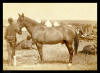
Click on photo to enlarge
Comanche –
1862-1891
Age: 29 (1891)
Height: 15 Hands
Color: Buckskin
Peculiar Markings: Left hind fetlock
white, black tail & mane, white saddle marks, small white star on
forehead, bullet wounds.
Condition: Unserviceable
Purchased By: Unknown
Date Unserviceable: June 25, 1876 from
wounds received in Battle of the Little Bighorn, Montana
Severe Wounds from Little Bighorn (three severe &
four flesh wounds): 1) through the neck; 2) just behind front shoulder
passing through; 3) in hindquarter, passing between hind legs.
Date of Death:: November 9, 1891 at Fort
Riley, Kansas and his remains mounted for exhibition by Professor
Lewis Dyche, for display at the 1893 Chicago Worlds Fair.
Present Location: On permanent exhibit at
the Natural History Museum, University of Kansas, Lawrence, KS.
Comanche was purchased in 1868 at a cost
of $90.00. Captain Myles W. Keogh, commander, Company I, 7th
Cavalry is said to have chosen Comanche as his personal mount in
September 1868, but this is disputed. Private James Severs, Company
M, 7th Cavalry is among those credited with discovering
Comanche on the Custer Battlefield, weak with bullet and arrow
wounds. He was nursed back to health and brought back with the
wounded to Fort Abraham Lincoln, aboard the Far West for recuperation.
After a lengthy convalescence in a special sling and stall at the
post, he soon became the venerated regimental mascot and accompanied
the regiment until his death at Fort Riley, Kansas on November 9,
1891. General Order No. 7, April 10, 1878 serves today as a fitting
epitaph to this old warhorse:
“HEADQUARTERS SEVENTH U.S. CAVALRY;
FORT ABRAHAM
LINCOLN, DAKOTA TERRITORY
April 10,
1878.
General Orders No. 7.
1) The
horse known as “Comanche” being the only living representative of the
bloody tragedy of the Little Big Horn, Montana, June 25, 1876, his
kind treatment and comfort should be a matter of special pride and solicitude
on the part of the 7th Cavalry, to the end that his life
may be prolonged to the utmost limit. Though wounded and scarred, his
very silence speaks in terms more eloquent than words of the desperate
struggle against overwhelming odds of the hopeless conflict, and
heroic manner in which all went down that day.
2) The
commanding officer of I troop will see that a special and comfortable
stall is fitted up for Comanche; he will not be ridden by any person
whatever under any circumstances, nor will he be put to any kind of
work.
3)
Hereafter upon all occasions of ceremony (of mounted regimental
formation), Comanche, saddled, bridled, and led by a mounted trooper
of Troop I, will be paraded with the regiment.
By Command of Colonel
Sturgis:
(Signed) E.A. Garlington,
1st
Lieutenant and Adjutant,
7th
U.S. Cavalry (Back
to Top)
Visit the
University of Kansas Natural Museum Comanche restoration project.
Battle Home |