By William Price
Webmaster's Note: William Price, an editor for a consulting firm
in New York, is the author of The Potlatch Run, a novel (Dutton,
1971) and articles in True West and Frontier Times. In his short
story, "A Secret for the Centennial," published in The Saturday
Evening Post in 1976 and this website,
a young boy meets a man who might be Isaiah Dorman. Bill also contributes
as co-editor for the Friends of the Bear Paw, Big Hole & Canyon
Creek Battlefields' website.
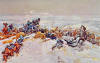
"The Fetterman Fight", by J. K.
Ralston
Almost
immediately after the Treaty of 1865, which granted the Sioux, Cheyenne,
and Arapahoe nearly all the Powder River country, the U.S. government
realized it had given away too much. The following summer, while trying to
rewrite the treaty, the government sent Colonel Henry B. Carrington with a
small army to establish three forts along the Bozeman Trail, a wagon road
that cut through the same country promised to the Sioux the year before.
Emigrants and miners needed a safe route north to the new goldfields in
western Montana Territory, and the army intended to provide it and keep it
open.
Despite objections from Red Cloud and other Sioux and
Cheyenne leaders, Carrington moved into the Powder River country the
summer of 1866. He garrisoned Fort Reno, which already existed, and by
July was hard at work building Fort Phil Kearny, in what would become
eastern Wyoming, and Fort C.F. Smith, further north in Montana. Once
completed and garrisoned with soldiers, the three posts would be permanent
government stations in Indian country.
Trouble From The Beginning
Holding most of his army on Big Piney Creek in
Wyoming, Carrington began cutting wood and building the new Fort Kearny.
What followed became known as “Red Cloud’s War.” Red Cloud let Carrington
know right away that the army was going to have a rough time of it.
First, he drove off most of the army horses. Supply trains came under
attack, and most of the wagons sent on wood cutting details were fired on.
By December, the Sioux and Cheyenne had gathered
large war parties, and Carrington felt besieged. The army had to be
supplied over many miles of rough country in worsening weather. With
winter already blanketing the Powder River country in snow, Carrington
needed all the wood he could get. It was going to be a long and cold
winter.
On December 21, the wood train came under attack
again. Captain William J. Fetterman, with 78 cavalry and infantry and two
civilians, rode to the rescue. Carrington’s last orders to Fetterman:
“Whatever you do, do not go beyond Lodge Trail Ridge.”
Like most of
Carrington’s officers, Fetterman, a veteran of the Civil War, believed
that Indians were no match for an army that had beaten Robert E. Lee.
Soon after he had arrived at Fort Kearny, Fetterman had boasted, “With 80
men I could ride through the whole Sioux nation.”
A Victory For The Indians
The story is an old one. Fetterman set out boldly to
rescue the wood train. The Indians sent decoy riders who easily pulled
him further from the fort. On the far side of Lodge Trail Ridge as many
as 2,000 warriors waited. Fetterman paused at the top of the ridge, with
an anxious Carrington watching through field glasses from the fort wall.
Then Fetterman went down the other side and out of sight, chasing the
decoys.
His cavalry, being in the lead, were attacked first.
According to Indian testimony, the fighting was fierce from the beginning,
continuing as the cavalry retreated back up the slopes, past the now
engaged infantry.
Firing single-shot carbines that had to be reloaded
after every shot, the soldiers were no match for warriors with thousands
of arrows. The 40-man infantry didn’t last long. The two civilians were
killed here, defending themselves with up-to-date Henry repeating rifles.
With their horses unable to maneuver on steep ground covered with snow and
ice, the cavalry had to turn them loose. For those waiting at the fort,
the sight of those riderless horses running toward home and the sounds of
the firing must have been heart-rending.
The soldiers, taking cover behind a rough circle of
boulders, defended themselves well. At the end, it was hand-to-hand, with
the bugler, young John Metzger, swinging his bugle against the Indians
that came up to kill him. Many years later, an Indian gave the battered
bugle to Jim Gatchell of Buffalo, Wyoming, and it can be seen today in
the fine Gatchell Museum in Buffalo,
Wyoming.
The next day, the Indians allowed Carrington to send
wagons for the dead. The Indians lost about 14 warriors. Red Cloud’s War
was effectively over. Although the army remained in their two forts along
the Bozeman Trail, fighting two tough battles with the Sioux at the Wagon
Box fight and the Hayfield fight near Fort Smith, the Indians won the war.
In the summer of 1868, the army pulled out of the
Powder River country, abandoning all three forts and handing the country
back to the Sioux. Carrington’s retreating army could see the smoke from
the burning Fort Kearny as they rode away. The Bozeman Trail stayed
closed for a long time.
The Aftermath
Many of the Indians who fought Fetterman – including
Crazy Horse – were on the Rosebud in 1876 to whip Crook and that same
month helped wipe out Custer. They won those battles, like they had
against Fetterman, but they lost that war. But after Fetterman they had
the glory – for almost nine years – of having won a war against the
whites.
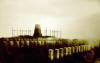
ca 1891 – 7th Cavalry Monument
and the Fetterman soldiers
Buried in the frozen ground at Kearny and left there
when Kearny was abandoned, Fetterman and his 80 soldiers were not
forgotten. In 1888, with the Plains Wars almost finished, the army went
back, exhumed the bodies, and carried them in wagons all the way into
Montana to the top of Custer Hill, behind the big monument. When remains
from other isolated frontier forts and battlefields began to be brought to
the new Custer Battlefield National Cemetery, Fetterman’s soldiers were moved again, in 1930,
down Custer Hill to join them. All of them, that is, except for the arm
bones and other small fragments found in 2003 during the construction of
the Indian memorial. This June 25, at 4:00 p.m., those bones will re-join
the rest of Fetterman’s men in a military ceremony sponsored by the
Friends. The last soldier will return to the regiment.
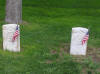
Fetterman & Brown gravesites,
Custer Battlefield National Cemetery -- Photo by Chris Dolby
Further
Reading On This Subject
Bill
Markland's Website -- many of the official reports from Col. Carrington,
Ten Eyck, and Surgeon Horton.
Book Review of Promise: Bozeman's Trail
To Destiny
John Doerner's
report on the discovery of the Fetterman soldier's remains
Friends of the Little Bighorn Battlefield
Projects 2004
Changing
Faces of Last Stand Hill
(Back
to Top)
|


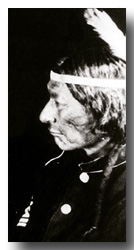 "A
few soldiers tried to get away and reach the river but they were all killed. A
few did get down to the river, but were killed by some Indians there. The
Indians were running all around shooting and yelling, and we were all very
excited."
"A
few soldiers tried to get away and reach the river but they were all killed. A
few did get down to the river, but were killed by some Indians there. The
Indians were running all around shooting and yelling, and we were all very
excited."