| Friends Of The Little Bighorn Battlefield |
The Next Generation In The Study Of Custer's Last Stand |
Memorial Tour |
| • The Battle • Archeology • Memorials • Little Bighorn Store • News • Book Reviews |
By Bob Reece
|
|||||||||||||||||||||||||||||||||||||||||||||||


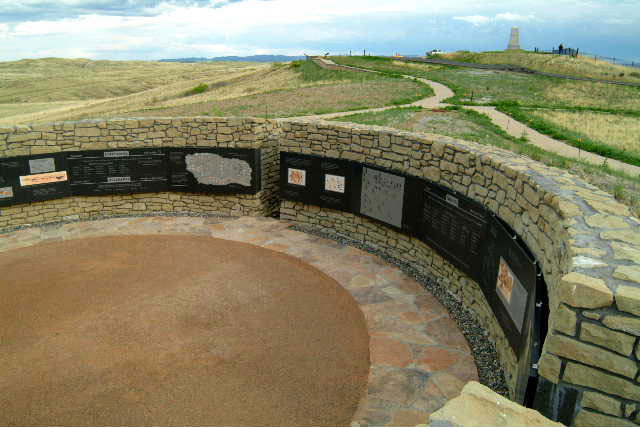
When you enter the Memorial, you enter another world -- somber, deep, retrospective, and sacred. The Memorial is in the shape of a perfect circle. In the center is a circle of red dirt. Around it is a circled stone walkway. On the inner walls sit panels for each tribe that fought in the battle (Sioux, Cheyenne, Arapaho, Crow, Arikara). Each tribe lists their dead and there are some pictographs.
You are immediately taken by the Spirit Warriors standing high above you to the north. The area is wide open so the Montana prairie shines through. If you turn around from the Spirit Warriors you look through a gap in the mound called the Weeping Wall. It is here that water continually trickles down into a pool representing tears for the fallen warriors and soldiers. And, centered perfectly within the Weeping Wall can be seen the 7th Cavalry Monument. This Spirit Gate welcomes the fallen soldiers to enter the Memorial and join the fallen warriors in friendship; “peace through unity.” Its symbolism is powerful in so many ways to say the least.
It is peaceful in this place, within this circle. When I stand inside the Memorial I feel that it has always been there but is just now showing itself.
The Panels
Photos © Joanne Blair
Along the walls inside the Indian Memorial are panels for each tribe that fought in the battle: Sioux, Cheyenne, Arapaho, Crow and Arikara. Below are photos of these panels. Imagine if you will that you've entered the memorial from the east and now standing in the center of the memorial. You turn around facing east and the first panel you see is for the Crow just to the left of the east entrance. These photos are arranged in the order you would see them if you started looking right completing the full circle with the Arikara panel.
|
|
|
|
|
|
|
|
|
|||


A Closer Look At Some Of The Panels
Photos below © Kris Nyström


Photos below © Jim Eshleman,
Hardin Photo, Hardin, MT. 406-665-2800
Webmaster's Note: Jim Eshleman is gracious to let us use his photos of the inside of the Indian Memorial. I think you would agree that these include some of the most unique perspectives seen of any photos so far of the memorial.




Join The Friends of the Little Bighorn Battlefield
Memorials Home
Indian Memorial Home
Copyright 1999-2013 Bob Reece
Revised:
Monday June 01, 2015
Friends Little Bighorn Battlefield, P.O. Box 636, Crow Agency, MT 59022
| Home |
Board of Directors |
Guest Book | Contact | Site Map
| |
|