Interment of the Custer Dead
By Bob Reece
It was
June 28, 1876, two days after the Battle of the Little Bighorn when the
surviving officers and soldiers of the 7th U.S. Cavalry began the
gruesome task of burying their fallen comrades. The bodies were decomposed, many
beyond recognition, bloated and black; the effects brought about by three days
of exposure from the intense sun thrashed upon the
Montana prairie. To make matters even more terrible, there were widespread
mutilations of the dead -- crushed or decapitated heads and disembowelments.
Soldiers were seen to stop their unenviable jobs to vomit or wipe away a tear.
The
first burial was incomplete, however, for there were only a handful of spades,
so most of the dead were covered with only a few token shovelfuls of dirt or
clumps of sage. More important were the wounded soldiers lying along the valley
floor in dire need of immediate medical attention – the nearest hospital was 500
miles away over land and down rivers. This army would have to move soon and
fast, so very little time could be given the dead.
The
exemplar burial was given to Lt. Colonel George Armstrong Custer – only 18
inches deep, but six feet compared to the other 200 plus 7th
cavalrymen. Stakes driven into the ground marked recognized officer’s graves.
The officer’s name was written on a piece of paper, rolled up and slipped inside
a spent cartridge, then pounded into the head of the stake for later
identification. Additionally, the graves were numbered on a map. The private was
not so lucky. His final resting place remained mostly unmarked; there just was
not enough time to cut stakes from the trees along the river or salvaged tipi
poles.
The field on June 28 was best described by Colonel John Gibbon, “…as thickly
lying in all conceivable positions and dotted about on the ground in all
directions are little mounds of freshly turned earth showing where each brave
soldier sleeps his last sleep.”
After the surviving soldiers were gone, predators scattered the
remains of Custer's 7th Cavalry across the field. Eventually, the battlefield gleamed with tens of thousands of
shining bones from man and horse. These would have to be reckoned with resulting
in many reburials over the next five years.
Actions To
Recover The Dead
Throughout
the following year pressures from family members were placed upon Army officials
to retrieve the bodies of the fallen officers. Lt. Gen Phillip H. Sheridan would
attempt to persuade the military to finance such a project. He sent a
heart-rendering letter to General Sherman dated April 4, 1877.
My dear General Sherman,
The wife and friends of the officers who were killed with Custer...are
pressing me to bring in their bodies, and I wrote to ask if the Secretary of War
will authorize the necessary expense. It is possible that there may be
sufficient incidental funds in the Adjutant General's office, or other funds at
the command of the Secretary, which can be used for this purpose. The sum
required will be small.
I propose, in case it meets with the approbation of the Secretary and
yourself, to bury all the bodies, except Gen. Custer, at
Fort Leavenworth. Mrs.
Custer wants Gen. Custer buried at West Point, and I recommend that she be
gratified in this desire.
I can detail an officer to bring the bodies down in suitable boxes to Fort
Lincoln and there transfer them to the proper coffins. The satisfaction it will
give to the wives, families, and friends of the officers will be very great.
I am, General,
Yours truly
P.H. Sheridan
Lieut. General
It should
be of interest to note Sheridan’s concern over receiving approval from the
government for the necessary funds to complete this endeavor. Apparently
Sheridan envisioned this issue to become a problem. The reality of the situation
was brought to Sheridan's attention with correspondence from the Adjutant
General Office dated April 18, 1877.
Lieut General P.H. Sheridan
Commanding Mil Div of the Mo
Chicago Ill
Sir:
I have the honor, by direction of the General of the Army, to acknowledge
receipt of your communication to him of the 4th...
The question was submitted, by the General, to the Secretary of War
who regrets that your application cannot be granted, for the reason that no
appropriation is applicable to the purpose, and the accounting officers do not
allow accounts for such expenses.
This news
must have grieved the surviving family members. The pressure to change this
decision continued with Sheridan and Sherman doing their part. These officers
always held a high regard for Custer, and in respect for his widow they most
likely wanted to see her wishes fulfilled. If anyone could change the opinion
of the military, these men would stand the best chance to accomplish that task.
The next
bit of news from the Adjutants Office surely brought a sigh of relieve to all
involved. In a letter dated April 28, 1877, addressed to Sheridan, the military
bowed to the pressure. In part it read,
Sir:
Referring to letter of April 18, 1877, from this office… I have now the honor
to inform you that upon a reconsideration of the subject the Secretary of War
has decided to pay, from the contingent funds of the Army, for the expenses of
bringing in the bodies of General Custer and the officers who fell with him --
as recommended in your communication of April 4, 1877 to the General of the Army
--
The Secretary of War requests that the expenses may be made as small as
possible.
The
underline is as originally written. Not much has changed; our government was
as frugal with its soldiers in 1877 as it can be today. Sheridan wrote the
Secretary of War in a letter dated May 7 requesting $1,000 for the project.
Being as diplomatic as possible he wrote, “An accurate account will be kept to
show the use made of the money.”
These official letters are
revealing: Custer and his fellow officers may have been forced to lie where they
fell for all eternity because the military initially refused to forfeit the
funding for their disinterment. Most students of this battle have a tendency to
think that no one questioned the idea of retrieving the remains of Custer and
his officers; it just happened. In fact, it was the pressure from the relatives
of Custer and his officers that finally pushed the army's leaders to change
their minds and begin the process for removal of some of the officers remains to
designated national cemeteries.
Officers Go
Home
On May 16,
1877, Lt Gen Sheridan directed his brother Lt. Col. Michael V. Sheridan to
retrieve the bodies of Custer and his officers. Escorting him to the battlefield
would be Company I, 7th Cavalry, commanded by Capt. Henry J. Nowlan
who knew the graves best for he originally helped stake the graves and map them
in 1876.
Arriving at
the junctions of the Little Bighorn and the Bighorn rivers, on June 29,
Sheridan's party found the 11th Infantry under Lt. Col. George Buell in the
midst of constructing Fort Custer. On July 1 the troops began the journey up the
Little Bighorn and pitched camp near the battlefield early on the morning of July 2. The grim task
would proceed on that day with men walking over the battleground placing tree
stems wherever a grave was found.
On July 3
the soldiers located, with the aid of the tree stems, exposed remains that they reinterred,
then the graves were well-packed and marked with cedar stakes. The bones
of the officers, including Custer, were exhumed and placed in coffins. The
officers disinterred included Capt Tom Custer, Capt Keogh, 1st Lt W.W. Cooke,
Capt George Yates, 1st Lt. A.E. Smith, Lt. James Calhoun, and 2nd Lt. William
Reily. Lt. Crittenden was buried where he fell as requested by his father.
On
Independence Day the soldiers continued their tasks on the Reno portion of the
battlefield -- bodies found in the valley and on the hilltop defense site were
reburied. Officers exhumed for points back east were Lt McIntosh, Lt. Hodgson,
and Dr. DeWolf. By midday of July 4 the coffins were on their way
back to Ft. Custer. Their long journey continued from there until finally
reaching Ft. Lincoln by steamboat on July 11.
Sheridan
would leave the field not only confident that he had completed his mission, but
that the battlefield looked better -- bodies were no longer exposed. However, the Custer
dead rested only a short time before powerful Montana rainstorms returned and
washed out the fresh graves -- erosion and predators continued in the scattering
of human remains.
Not long after the troops were gone, photographer John H. Fouch visited the
battlefield where he captured
the very first photographs of the carnage. His accomplishment would be
overshadowed by Morrow’s photographs taken in 1879 and believed for decades to
be the first taken of the field, however research of the late Dr. John Gray and
Friends' member Dr.
James Brust disclosed Fouch's historical importance at last.
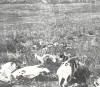
Photo by John H. Fouch,
courtesy of Dr. James Brust
Later that summer Phil Sheridan personally visited the
battlefield already finding it in a most hideous condition. It must have made
him gasp but he also realized the extreme difficulty in permanently burying the
dead. He ordered Lt. Col. George Forsyth
to make the field presentable.
In his
official report to Sheridan dated April 8, 1878, Forsyth described the burial
detail of July 21, 1877. 60 enlisted men and three officers equipped with
"spades, shovels, and picks...made a thorough and careful survey of the
battlefield.”
The report
acknowledged problems with the soil being absent of clay or stones causing easy
erosion, yet the graves were as good a condition as could be expected. The
duration of this project took “over four hours” and a “total number of skeletons
or parts of skeletons reburied was seventeen.” Forsyth described a respectable
scene of the operation that resulted, in his opinion, of no human bone left unburied. However,
he concluded his report with a grisly prediction. “I do not think that there
will ever be a time in the spring, or after the spring rains, that portions of
skeletons will not be exposed, if the remains are left there…” Forsyth left the
battleground with soldiers buried, but many horse bones still littered the field
exposed for all to see. No one, as of yet, had made an attempt to clear the
field of this decay.
In just
over a year after the Battle of the Little Bighorn there had been a total of
three burial parties. Forsyth's concerns of exposed skeletons would become known
as stories circulated back east of soldier's bodies
enveloping Custer Battlefield and dragged about by animals.
The horror
troubled General Terry to the point that he deemed it necessary that the
soldier’s remains should be gathered and buried together. He ordered Lt. Col.
Buell of Ft. Custer for such a mission, but the order arrived during the early
winter of 1878. Because of harsh Montana winters, the expedition would not start
until April of 1879.
First
Monument 1879
Capt. George Sanderson led the 11th Infantry and accompanying him was the famous
photographer Stanley J. Morrow.
His photographs of Last Stand Hill and the bleaching horse bones include some of
the most recognized in today’s history books.
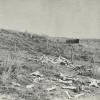
Stanley Morrow 1879 -- courtesy Little Bighorn
Battlefield National Monument
The Sanderson mission gathered as many of the horse bones as possible. Even
though Sanderson's orders did not require as such, his men did their best to make the field look more presentable. And, Sanderson would build the first monument to the
fallen soldiers. In his official report dated April 7, 1879, Sanderson wrote, “I
accordingly built a mound out of cord wood filled in the center with all the
horse bones I could find on the field. In the center of the mound I dug a grave
and interred all the human bones that could be found, in all, parts of four or
five different bodies. This grave was then built up with wood for four feet
above ground. The mound is ten feet square and about eleven feet high; is built
on the highest point immediately in rear of where Gen’l Custer’s body was
found…” That was just Last Stand Hill.
For the
remainder of the battlefield, Sanderson’s soldiers buried the
rest of Custer’s soldiers where they were found. Each grave was marked with a
new stake at each head. Sanderson's report stated that “The whole field now
presents a perfectly clean appearance, each grave being remounded and all animal
bones removed.” The fourth burial since the Battle of the Little Bighorn was
finished, but Sanderson must have felt that it was somehow incomplete for he
continued in his report, “I would respectfully suggest that…either all the
remains be gathered together and placed in one grave and a stone mound be built
over it, or that stone headstones be placed at each grave as they now are.
Either would be an enduring monument.”
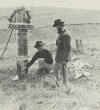
Stanley Morrow 1879 -- courtesy Little Bighorn
Battlefield National Monument
Final
Monument 1881
This “enduring monument” and
final reburial would occur in July of 1881. The 2nd Cavalry under 1st
Lt. Charles F. Roe built a foundation and placed the granite monument, as we
know it today, on Last Stand Hill. It's a myth that the elevation of Last Stand
Hill was drastically lowered; minimal
grading was done to level the spot where the monument was placed.
Today, Last Stand Hill sits very much as it did at the time of the battle.
Roe would do his
utmost to prepare a final resting place for the soldier’s remains. From Roe's
description, he made it probable that nothing except a backhoe would be able to
dig out the soldier's remains. His official report dated August 6, 1881 reads in
part:
The stones were then placed in position and a trench dug ten (10) feet from base
of monument on four (4) sides, for the remains. I took great pains in gathering
together all remains from the Custer Battle Field, Reno's Hill and the valley,
giving it my personal attention...so that I feel confident all the remains are
gathered together and placed at base of monument, stone put immediately on top
of remains, and then earth, so that now they are well buried and will never be
exposed again in all human possibility.
Five years
after the Battle of the Little Bighorn, the dead finally came together to lie
near where their commanding officer fell. Roe was impressed enough with this
place to suggest a means for future visitors to have a better understanding of
the battle. His report states, “Whenever I found the remains of a man, I planted
a stake well in the ground, so that future visitors can see where the men
actually fell.”
Marble
Markers 1890
Today we
walk the battlefield, thanks to the vision of Roe, observing not stakes but
marble markers depicting approximately where soldiers fell. Company D 25th
Infantry placed 249 markers on the battlefield in early May of 1890, led by Capt. Owen
Jay Street. In his official report dated May 15, Street makes mention of bodies
still being found exposed throughout the battlefield. “During the search for
bleaching skeletons of men were found and for some reason of neglect had
remained unburied and with God's canopy alone to cover them for fourteen years.”
Once again soldiers would be buried and reburied.
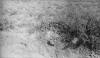
1936 Photo by
Joseph G. Masters
showing open grave,
courtesy Western History/Genealogy
Department, Denver Public Library
Many
officers and soldiers did their best to respect the fallen and give them the best
possible burials, but it is safe to presume that the final installment of the
interments of Custer's soldiers has not been written. Remains were discovered in
the summer of 1958 at the Reno Benteen Battlefield. The powerlessness of the
1876 burial party to stake each soldier's grave probably contributed to many
remains being lost over the ages. Most recently during the
archeological digs in May 1984 and 1985, portions of skeletons were uncovered
throughout the Custer Battlefield.
Their remains patiently lingered, just off the beaten
path of tourists and buffs, for discovery and the contemplation of their demise.
How many more lay on the barren fields of Montana
cannot be conjectured, but surely not all of Custer's soldiers have come home.
"Dust to Dust" Copyright 1985 by Bob Reece
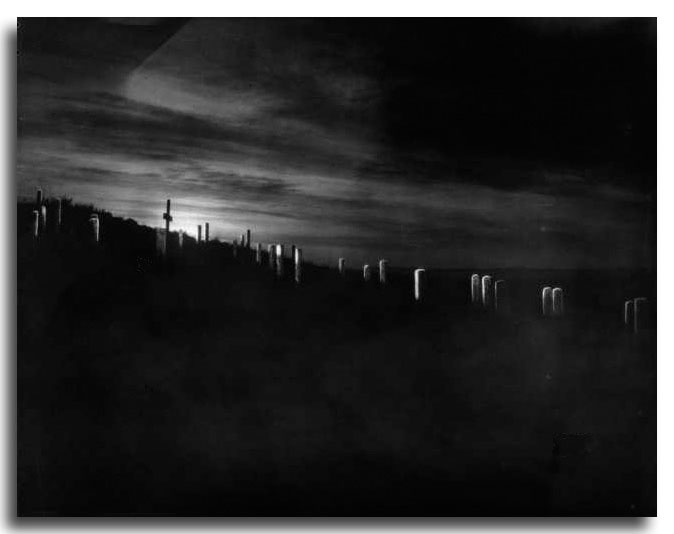
"Sunrise on Custer Battlefield" photo by
Richard Throssel,
courtesy Western History/Genealogy
Department, Denver Public Library
Other Areas Of
Interest
Indian Memorial -- Newest Monument Near
Last Stand Hill
Changing Faces of Last Stand
Hill
Inside the Fence
Postcards from the Edge
(Back
to Top)
|