More to See >>
Read The Thesis

"The Little Bighorn
Battlefield National Monument and an Indian Memorial After 1988"
By Friends Member, Megan Reece
Copyright
© 2005, Megan Reece.
This thesis cannot
be reproduced without permission from the author.
Webmaster's Note: The fascination with the Battle of the Little
Bighorn never dies. It's been nearly 130 years since George Armstrong Custer and
268 of his men fell in a hard-fought battle with Lakota and Cheyenne Indians.
Yet, every new generation carries the torch in searching for the truth; Megan
Reece is proof of that. She successfully completed her undergraduate honors
thesis in History from the University of Colorado at Boulder in the spring of
2005 receiving Magna cum laude. “The Little Bighorn Battlefield National
Monument and an Indian Memorial After 1988” chronicles the history of the Indian
Memorial and it is an eye-opener. It is honest, quite in depth for an
undergraduate thesis, and it should answer many unanswered questions about how
the Indian Memorial came to be. It might prove controversial with certain
groups, but that is always expected when truth in reporting of history is
published.
To access the thesis just click on the link
above at "More to See." The file is a pdf which is readable via the free
software from Adobe Reader.
If you don't have Adobe Reader installed on your computer,
go to --
http://www.adobe.com/products/acrobat/readstep2.html -- to get the
free download. You do not need to worry about downloading Adobe Reader -
this company is highly respected and they will not transfer a virus to your
computer when downloading the software.
Now, I turn this over to Megan where she'll
give you some background regarding her work on the thesis.
I wanted to write like Hunter S. Thompson, so I decided to become a journalist
when I entered the University of Colorado. It did not take me long to realize
that it was the writing I loved, and not the cut-throat attitude or that
dog-eat-dog mentality that came along with my chosen profession. I was not
about to give up my coveted spot in the School of Journalism and Mass
Communication, or the skills I knew it would teach me, but I was beginning to
hate every part of school.
By the start of my junior year, I
knew I had to make a change. I tried to come up with a way to stay in
journalism for the skills it would teach me, and to stay happy with my education
at the same time. History was the answer; it had always been a hobby for me,
and I had used up most of my required “elective” credits on classes about
medieval Europe, ancient Rome, colonial U.S. history, and more. I decided to
tack on another major. I would become a double degree student, and straddle the
journalism school, as well as the School of Arts and Sciences. I went to visit
my future history advisor, Patrick Tally, and his eyebrows lifted at the sight
of my transcript. “Your GPA is good enough if you would like to enter the
honors program,” he told me. I would have to keep my GPA above a 3.5. Easy.
“And, you’ll get to do an honors
thesis, too,” he said. I was not sure if I had heard correctly.
“A thesis,” I asked, “Like, a REAL
thesis?” Sitting there in Tally’s office, I immediately thought, “The Little
Bighorn.” There was nothing else that I could imagine writing about. I still
had one and a half years to go before I started the honors program, but I was
already formulating my thesis.
One year later, when I told
Virginia Anderson, the professor for the prepatory course about my topic, she
puzzled over who should advise me during the process. She put me in contact
with Professor Peter Boag, who had studied the American West to a great extent.
She seemed to think he was the only one who might be able to help me slog
through my relatively obscure topic.
Once I was accepted into the
honors program, I began the long process of refining my topic. I knew I wanted
to focus on the Little Bighorn Battlefield, but I was not yet sure on which
aspect. I had watched my dad and his friends struggle for years to get the
Indian Memorial built and dedicated, and realized that I had as much passion for
the memorial as anyone. After its dedication in 2003, I had become even more
interested in why it took so long to be built. Eventually, I realized that my
exact topic was staring me in the face.
I suggested this idea to Boag, and
he informed me that a topic as wide as “why” would fill up much, much more than
seventy five pages. “Pick a year,” he said. “Pick a particularly influential
year and write about why that year contributed to the memorial.” Now I was
getting the idea. When I talked to Dad, he suggested I focus on 1988. I had
been considering 1976, but then I realized that both of those years were pivotal
in getting a memorial going. 1976 led the way to 1988, which opened the door to
the years that followed. At last, I had a narrow enough topic with which to
write a thesis.
I do not know exactly when I
decided to finally put my journalism skills to good use, but once I had a topic,
I began to understand exactly how much journalism could help me. Unlike the
other honors history students, I had a topic that, though it was linked to
long-past events, had happened in contemporary times. Many of the people who
had witnessed these pivotal years were still alive, and I knew that they might
be able to add a richer dimension to my thesis on the struggle for the Indian
Memorial.
I made a quick laundry list in my
head of who I might be able to talk to about my topic. Robert Utley, Jerry
Greene, John Doerner, and Neal Mangum were the first four people who popped up.
They knew more about the battlefield than anyone else I could think of, and I
knew that if they would help me, I could really make my thesis into something
special. I had hoped to talk to Russell Means as well. I knew his role was
crucial to the Indian Memorial, but alas, my e-mails to Means went unreturned.
As I continued researching and
refining my topic, I decided that Paul Hutton would be an asset as well because
he had served on the memorial committee. I also thought that Ernie LaPointe
would be interesting to talk to because of his relation to Sitting Bull. I sent
LaPointe an e-mail asking for his help, and he wrote back. He was flattered, he
explained, but he did not believe that he was the man to talk to about my
subject, so he sent me in the direction of his good friend, Chauncey Whitright
III.
I began the process of
interviewing by sending Utley a long list of relatively scattered questions, and
I eagerly awaited his response. I learned a great deal from that first
correspondence, and I knew that I still had a huge amount of research to
conduct. I learned that I had developed theories of my own without the proper
amount of research to support them, and I resolved to answer the questions I
still had.
Utley helped me to see that a good
piece of writing is more than just asking questions; it is also about pouring through books, articles and letters in order
to find the answer to your question. Research at this level is dusty, tedious,
and to any proper historian, absolutely delightful. Along with his helpful
answers and insights, Utley also sent me in former NPS Regional Director John Cook’s
direction. At last, my list of interviewees was complete.
My next interview was in January
2005 with Jerry Greene. I looked forward to this one particularly because I
knew Greene through Dad well enough to be comfortable at an interview. Also,
because Greene’s office is in Denver, I was able to drive up from Boulder
to meet with him in person. I knew I would have
to rely heavily on what the journalism school had taught me. I arrived, armed
with several blank notebooks, audio tapes, and a tape recorder, as well as some
of Greene’s books that Dad hoped to have inscribed.
I was immediately comfortable in
Greene’s office; he was as kind and patient as I had remembered, and he answered
every question with thoughtful knowledge. I also loved the fact that he did not
offer one-word answers. His comments were in “essay” form; I guess that happens
when a person studies history for a living! I left Greene’s office with renewed
confidence, but also with apprehension. I knew that I still did not have enough
hard, dusty research to write a thesis. Luckily, I had a good idea about where
to look.
During my prepatory class,
Anderson told us about a scholarship that the History Department offered one
honors student every year. Each year, the Charles Middleton History Scholarship
awarded $500 for a student to travel and research his or her thesis topic. I
figured I could easily get to Montana with less than $500, so I applied and then
forgot about applying. A month or so later, I received an e-mail from Professor
Padraic Kenney asking for more details about my topic, and how exactly I would
spend the scholarship money if I won. With surprise, I wrote back and gave more
information. A few days after that, Kenney informed me that I had won the
scholarship.
I was more shocked than excited.
I really did not think I would win; in fact, I had not even told anyone but my
close friends and family that I had applied. I certainly had not informed Park
Historian John Doerner of my intentions of visiting. After Kenney e-mailed me,
I contacted Doerner and explained the situation. I asked if it would be alright
if Dad and I came to the battlefield in February, and if I could research in the
White Swan Memorial Library while I was there. He replied excitedly that, of
course he would have us, and he agreed to let me interview him in person while I
was there. Dad and I could hardly wait.
Dad and I saddled up in the first
week of February 2005. The weather was beautiful and gracious, and our snazzy
little rental car made the trip in record time. I had never seen the
battlefield in the winter before that week, and it was even more amazing and
intriguing than during the summer season. The apartment was wonderful; Dad and
I went grocery shopping in Hardin, and then returned and happily prepared dinner
on our first night there. That night, I could hardly sleep because of my
excitement for the research to come.
Doerner greeted us at the library
the next morning and I immediately began my search. Doerner kindly pointed me
in the direction of all the documentation on the Indian Memorial and I started
to pore through the file cabinet drawers. I sorted through newspaper clippings,
letters, photographs, and design sketches, as well as binder after binder of old
LBHA Newsletters and CBHMA Dispatches. Most of what I found was
profoundly interesting; the most difficult part was deciding which pieces to
include in my thesis.
During the evenings, Dad and I
would talk, and I began to get a clearer and clearer picture of exactly what I
wanted to address in my thesis. I did not want to offer only a history of the
memorial itself, but also a glance at the vehement politics and arguments behind
the memorial. I knew that not everything behind that memorial went smoothly or
beautifully, and I wanted to show that those hitches made the completed memorial
even more amazing. The memorial was much more than a design, I concluded; it
was also a living, speaking story.
My trip to Montana was, by far,
the most valuable thing I could have ever done to make my thesis into what it
became. Not only did I find uncountable sources at the battlefield, but I also
found a true path to my completed project, priceless knowledge about my subject,
and a few new friendships that I will treasure far into the future. When Dad
and I headed back home after five days, I knew I was ready to start writing.
The peace of our trip was quickly
shattered when I got back home and reality hit. I realized that I had a grand
total of two months to write my entire thesis, not to mention all the time it
was going to take to read in detail all of the sources I got from the
battlefield. I also had several interviews to do.
The rest of the interviews were my
islands of mercy in the disaster that was my thesis in February. I knew that I
could enjoy remarkable and educational conversations about my topic, all for the
benefit of research. Those conversations beat writing the darn thing any day!
I e-mailed a list of questions to Whitright and to Cook, and each of them
responded with insightful – and incredibly useful – information. Their thoughts
added a new layer to my thesis that was slowly building itself.
I conducted telephone interviews
with Mangum and Hutton, and found both of them as easy to talk to over the phone
as they are in person. I appreciated the undivided attention that I was able to
get from these historians over the phone; they offered me tidbits of
information, anecdotes, and powerful insight that I could never have picked up
from a book. There truly is nothing like talking to the individuals who lived
through a special time in history for picking up on the happenings of the time.
One day, I woke up and realized
that my research was finally done. I suddenly had a coherent outline in my head
for exactly what my thesis would say and how it would be explained. That was
when the real writing began. I had been writing a miscellaneous chapter here
and there and offering them to Boag for his critiques, but all in all, not much
had happened on the writing front by the time March rolled around. I knew that
I had until April 4, and panic began to set in. For me, though, that panic is
what fueled my writing. I knew the time was close, and that inspired me. The
thesis came together word-by-word, page-by-page, and chapter-by-chapter.
Instead of bringing one chapter a week to Boag, I began bringing two or three.
For about a month, I neglected my
family, my friends, my dog, my responsibilities, my other classes, and my
general health to turn all of my attention on finishing my thesis. One day, my
friend Liz called me and begged me to take an evening off of writing to hang out
with her, our friend Chris, and my boyfriend, Ron. “It’ll only be for a few
hours, I promise,” Liz said, “You really need to get out for a while.” She was
right; after the get-together, I returned to work more refreshed and more
excited than I had been in weeks.
One evening, I put the finishing
touches on my chapter about the 1988 protests and realized with a start that I
had completed the initial writing. All that I had to do to finish completely
was edit and re-write. That was a great feeling; I finally could see the light
at the end of the tunnel.
Boag helped me get through the
editing process, but I could never have finished without Dad. I sent every
chapter his way and he looked each one over and sent me suggestions on how to
make my points more clear. He also looked my writing over for accuracy; he had
the knowledge to catch mistakes that Boag would not have known about. Without
Dad’s help, my thesis would have only made sense to the people who know almost
nothing about the Indian Memorial, and that was certainly not my intended
audience! I finished my thesis, bound it, and turned it into the Honors office
at CU with time to spare. Now, I had to survive the defense.
I had already selected my defense
committee; it would consist of Boag, Honors History Chair Professor Fred
Anderson, and my favorite professor of all time, Douglas Burger. Despite the
great relationship I had with all of these professors, I started sweating before
I even sat down in the tiny defense room. Burger arrived first, and when I told
him how nervous I was, he reassured me that the defense process was really more
of a conversation. “They should really change the name,” he said, and smiled.
I felt just a little better after that.
The defense was actually a
wonderful and enlightening experience; it really came down to me blabbering on
about the battlefield and the Indian Memorial for an hour or so. The committee
asked some tough questions, but I knew enough about my topic to tackle each
one. Anderson stumped me once, though. He asked what the Little Bighorn
Battlefield might have in common with other Indian battlefields around the
country. I had a hard time thinking of much of anything that was not too
obvious. Anderson is a colonial American historian, and he pointed out that,
when the American Indians won, battlefields were often named after the losers,
but when the soldiers won, their side was glorified as well. Anderson named a
few battlefields out east, but I had a couple running through my head already;
Custer Battlefield and the Fetterman Fight, for example.
I left my defense sweaty but
relieved. Now, all I had to do was wait to find out my honors designation. I
wanted Summa cum laude – the highest honor – so bad I could taste it. I kept
visualizing a purple ribbon around my neck. I knew that any honors would be
great, whether it was Magna cum laude, or cum laude, but the perfectionist in me
wanted Summa. One week later, I walked up the stairs in the Norlin library on
shaky legs. I found the bulletin board with the honors designations. I
purposely covered up the honor titles with one hand while my other hand searched
for my own number. When I found it, I uncovered the other side and prepared
myself. “Even cum laude is great, Megan,” I whispered, “You worked hard. Any
honors are amazing.” Next to my identification number was one word: “Magna.”
My heart sank and lifted at the same time.
I left Norlin confused about how
to feel. I called my boyfriend, Ron, and left him a message with my news. He
called back and screamed, “Congratulations!!!!” He seemed to think it was just
great, but I was still trying to let it sink in. I called Dad and Mom, too, and
they were both just as excited, but I could not shake that slight disappointment
that I had not received Summa. I did get used to the idea, though, and by that
evening, I was celebrating along with the rest of them. Later, during the
honors convocation before graduation, I learned that only one history honors
student had received Summa. Magna was looking look better and better.
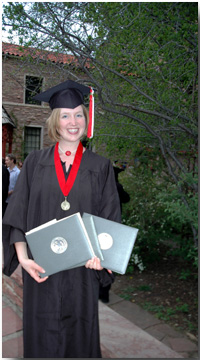
The convocation was truly one of
the best moments of my life. I was so proud, and all of my family and friends
who had gathered to watch me receive my medal and honors certificate were as
excited as I was. Mom, Dad, my brother Austin, Ron, and most of Ron’s family
lined up in the back, and when I crossed the stage, they screamed long and
loud. I looked over and saw Dad snapping pictures, and I saw the smiling faces
of many of my professors – including Doug Burger – who had helped me reach this
point. I would have cried if I had not been so busy smiling.
Megan Reece
May 2005
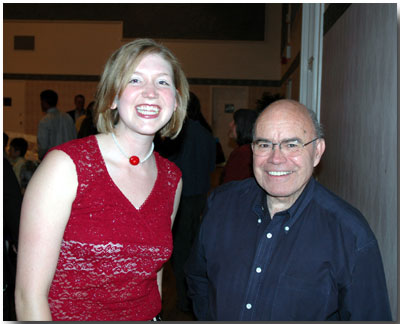
Megan with her "favorite professor of all time",
Douglas Burger
(Back
to Top)
|