Washington Post Obituary |
Memorial Service June 23
|Tribute to Brian from
"The Wild Geese" |
Give To The Civil War Preservation Trust In Brian's Name
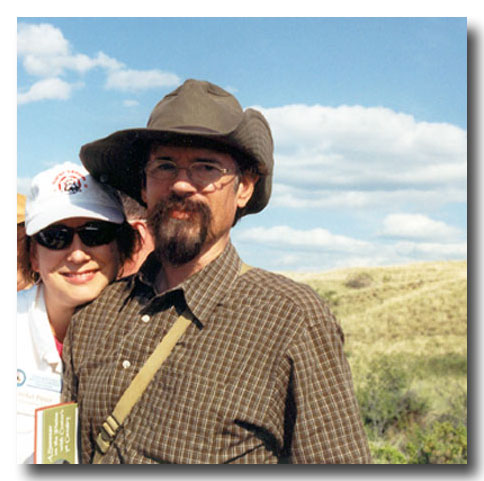
Brian and Cricket Pohanka, Deep Ravine Trail, June 25, 2004
Photo by Megan Reece
I lost a friend today, June 15, 2005 with the passing of Brian Pohanka. The Little Bighorn Battlefield National Monument lost a friend today
too. And all students of the Little Bighorn Battle, the Civil War, and Indian
Wars lost a friend as well. Brian Pohanka’s legacy covers a wide berth, and his
being gone creates a massive gulf in the field of historical research in all
these subjects that will be difficult to fill.
I remember the first time I met Brian – it was June 1983 at
the LBHA conference in Billings, Montana. The late John Carroll used to have a
welcoming party for the members in his motel room. When I first entered the room
there was Brian receiving a hug from Carroll. Carroll told me that this young
man was one to watch in the field of history. Carroll was right.
Brian established himself early in the television world of
history. He was a consultant for the long running, “Civil War Journal” which aired on the History Channel. He was also used as
a talking head – any episode of
this great program you are fortunate to view, you’ll recognize Brian
throughout.
Brian also made his mark in the film world providing
consulting services for “Gettysburg”, “Sommersby”, “Glory”, "Gods and Generals", and most recently,
“Cold Mountain” where Brian can be seen and heard on some of the extra features
of the DVD version.
I was very lucky to spend many Junes walking the Little
Bighorn Battlefield with Brian, riding beside him on the bus during the CBHMA
field trips, or sitting across from him each of those evenings at Little Big Men
pizza parlor in Hardin, Montana discussing the battle.
Brian loved the battlefield and the people that protected
it. Brian gave countless hours of his time helping the National Park
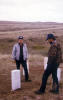
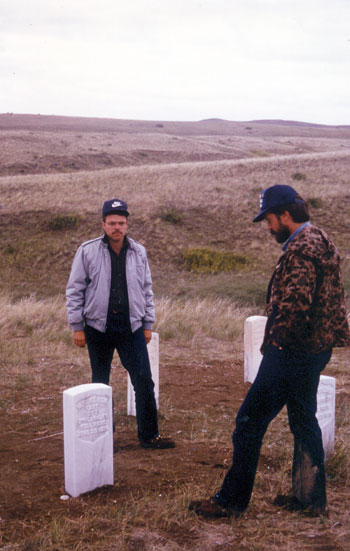
Service. In 1982 Brian’s research proved that the
white marble marker for Myles Keogh had been moved to a different location from
its original spot. Why, no one knew, but Brian convinced then Chief Historian
Neil Mangum that Keogh’s marker should be moved. And it was. One of the photos
below is of Brian standing beside Keogh’s marker in its correct location.
My most memorable experience was working with
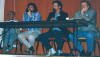
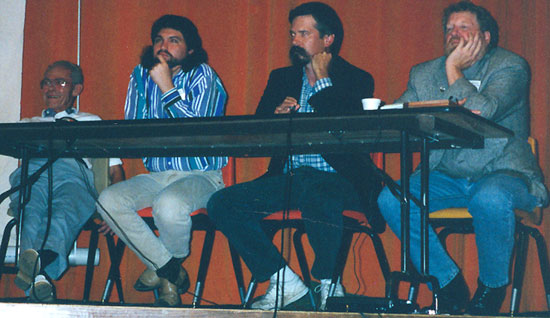
Brian on the CBHMA 1995-1997 symposiums, which I chaired. Brian presented papers at the 1995
and 1996 symposiums, and he participated in the panel discussions all three
years.
The 1996 symposium especially stands out in my mind. As I
prepared for the symposium, I called Brian and asked him if he’d be willing to
participate again as a presenter. He asked what I had in mind and I explained I
wanted to touch the hearts of the audience for the first time. I had grown tired
of the usual presentations explaining where soldier companies were positioned,
or papers asking the same old questions like, did Custer and Benteen disobey orders, or was
Reno a coward? I wanted to move the audience by bringing the human side of the
story to the forefront – to remind the audience that the men who fought and died
at the Little Bighorn were men who loved, had wives, and children.
Brian said he had something in mind. He had access to Annie
Yates diaries. Her husband, Captain George Yates of Company F, died not far from where Custer fell. They had a
precious love, Brian said. Brian titled his paper, “Romance and Tragedy with the
7th Cavalry: The Story of George and Annie Yates” and it moved the
audience for sure. Brian expanded this to a book, which he released during the
summer of 2004 titled, “A Summer on the Plains with Custer’s 7th
Cavalry: The 1870 Diary of Annie Gibson Roberts.”
Brian’s latest book will be published in the fall of 2005 and
I think it will be a wonderful legacy. “Where Custer Fell: Photographs of the
Little Bighorn Battlefield Then and Now” is authored by Brian along with his
friends James Brust and Sandy Barnard. It will include countless photos of the
battlefield over the years with contemporary photos taken from the same vantage
point as the historical photos.
The
best time I had with Brian was during the 1989 archeological dig at Little
Bighorn. He and I had spent two days on our knees digging in the ground at the
Reno-Benteen dumpsite finding nothing but hard tack box nails and wolf spiders.
Our saving grace was when Dr. C. Vance Haynes pulled the two of us off the dig
line and put us on a special secret mission. We were going to be part of a team
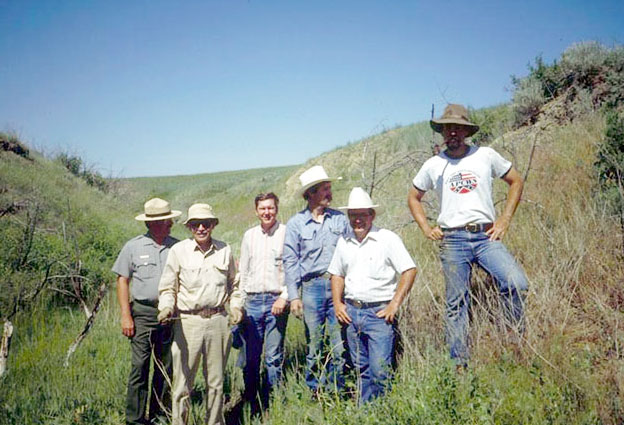
to find the missing 28 troopers in Deep Ravine. Besides Brian, Vance, and myself
the team included Dick Harmon and the western artist, Ralph Heinz.
We used a hand auger and drove that long tube deep into
the ground below the water table, brought it up and all of us grabbed handfuls
of mud. We felt through the mud feeling for human remains, buttons, bullets, and
such. The mud dropped from our fingers began to accumulate in great quantities.
While some poor fellow started
digging the next round we spent our time talking about the battle, weapons used,
and other fun stuff. All of us noticed Brian playing with the mud
piles on the ground. His fingers moved with precision on a delicate mission.
Coming from this historians' hands were accurate renditions of human faces --
three-dimensional. Brian was sculpting the missing troopers. Even though we
never found the missing troopers those three days in Deep Ravine, Brian kept us
entertained with his masterpieces.
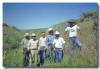
Brian
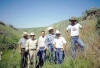
Pohanka far right, Deep Ravine, 1989
The most comfortable moment with Brian was when he
and his wife Cricket would spend Sunday mornings with my family eating
breakfast at the bed & breakfast. Brian and
Cricket stayed at a different motel, however, the owners of the B&B
graciously opened their doors and breakfast table for Brian and Cricket. It was
always a warm time seeing Brian and Cricket together – they beamed with
happiness.
The breakfasts were hardy and the stories Brian happily
shared with us were always most interesting. He always had my son, Austin’s
undivided attention especially when Brian spoke about Gettysburg. I’m really
going to miss moments like those with Brian gone.
Brian’s personal battle against cancer finally ended today,
but he finished life with grace, dignity, and love. In a card he sent me dated
February 3, 2005 Brian stated, “I’ve been able to keep up with my writing and
also Civil War living history – time is certainly not on my side, but I’ve been
blessed for what I’ve had.”
Brian, we all were blessed knowing you and I’ll miss you
terribly. My prayers are for you and your wonderful wife Cricket.
God Bless You,
Bob Reece
Cricket Pohanka has asked those to remember Brian by
continuing to help his cause for Civil War preservation by donating in Brian's
name to the
Civil War Preservation Trust.
|
|
|
|
Brian Pohanka on the right standing before the Keogh marker. His friend, John, stands left. June 1985
|
|
|
|
1995 panel discussion -- left to right: Joe Sills, Mike Moore, Brian Pohanka, and Richard Fox
|
|
|
|
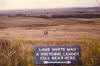
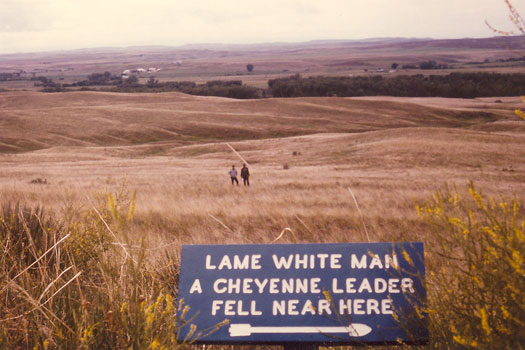
Brian and John stand beside the rock cairn for Lame White Man. June 1985
|
|
|
|
Deep Ravine 1989 Arch Dig Crew; l to r--Then Acting Supt Doug McChristian, Dr. Vance Haynes, Bob Reece, Ralph Heinz, Dick Harmon, Brian Pohanka
|
|
|

(Back
to Top)
|

 |
|